

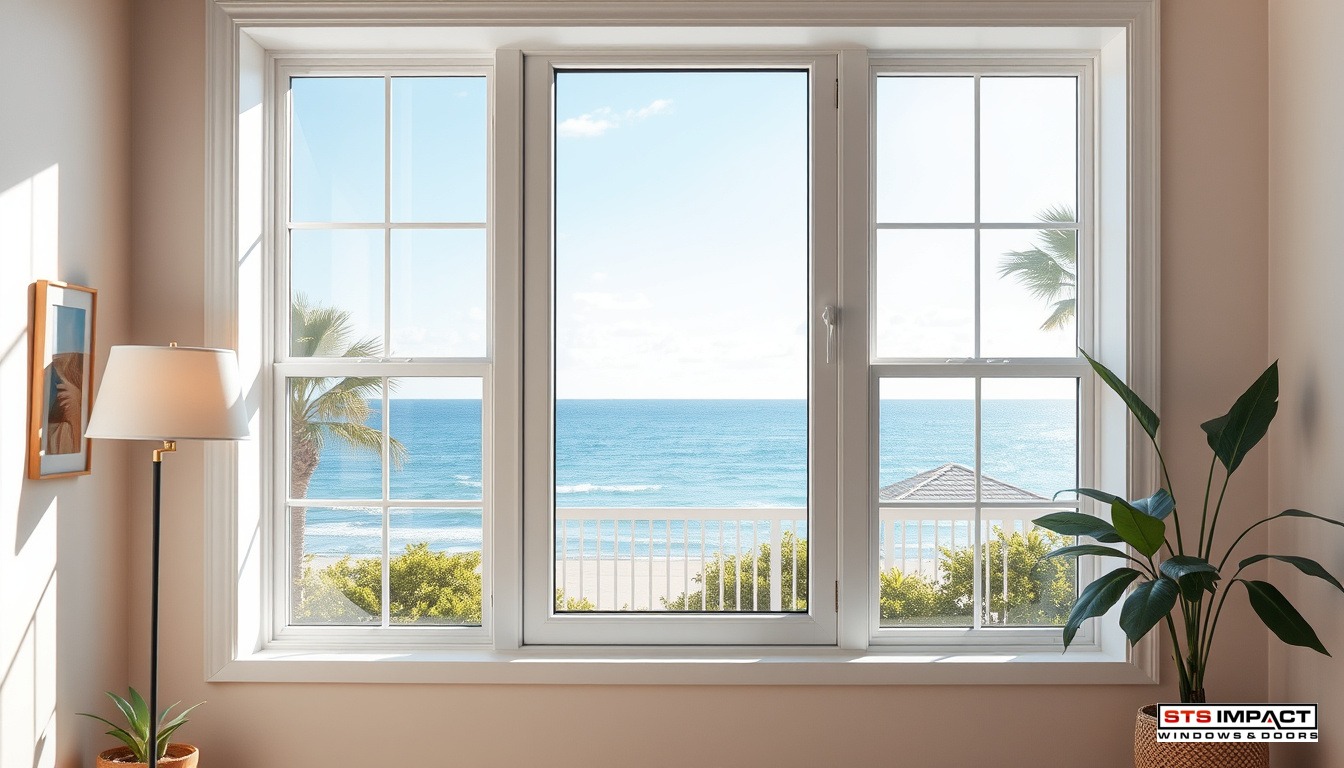
Why Casement Impact Windows Are a Different Conversation Entirely
Most homeowners shopping for storm protection think about impact windows as a single category. In reality, the style of window you choose changes almost everything: how air flows through your home, how much natural light you get, and how well the frame holds up against South Florida’s relentless humidity and salt air. Casement impact windows sit in their own lane. They crank open on a side hinge, sealing tightly against the frame when closed, which gives them one of the best air-tightness ratings of any operable window style.
For homeowners along the coast between Yamato Road and Glades Road, that seal matters. Salt-laden air finds every gap in a poorly fitted window, and casements close with a compression seal that most single-hung or horizontal roller windows simply cannot match. That means better energy performance, less infiltration during a storm, and quieter interiors when the afternoon thunderstorms roll in off the Atlantic.
The compression seal also explains why casement impact windows Florida building codes treat these frames favorably in high-velocity hurricane zones. When the sash presses against the weatherstrip under crank tension rather than sliding past it, the result is a more consistent barrier across the full perimeter of the glass. For homes near Military Trail or the areas west of US-1, where wind exposure can vary by block depending on tree cover and building orientation, that consistency is worth paying attention to.
How Casement Frames Perform Differently in Salt-Air Conditions
Aluminum frames are common across impact windows and doors Florida installations, but casement windows put specific stress on their hardware that other styles don’t. The crank mechanism, the multi-point locking system, and the hinge arm all need to resist corrosion over years of exposure to coastal air. Lower-quality casement hardware corrodes within a few seasons, making the window difficult to open or, worse, difficult to close fully during an approaching storm.
That is why the brands used for casement impact windows matter as much as the glass itself. Manufacturers like PGT Impact Windows & Doors and CGI Impact Windows & Doors engineer their casement hardware specifically for coastal climates, using marine-grade finishes and stainless components in areas that contact salt air. Comparing window suppliers who stock frames versus contractors who work with engineered coastal products is a critical distinction many homeowners miss until after installation.
Ventilation and Interior Comfort — What the Numbers Show
A fully open casement window captures nearly 100% of its frame area in usable airflow, compared to roughly 50% for a single-hung or horizontal roller. In a South Florida home without whole-house mechanical ventilation, that difference is noticeable on mild winter mornings when you want cross-ventilation instead of air conditioning. Homes along the quieter streets east of Congress Avenue, near the Delray Beach train station corridor, often have a mix of older single-hung windows and newer replacements. Swapping even a few key openings to casement style can shift how air moves through the main living areas.
If you want to understand how impact windows in Florida differ by style and which configurations qualify for specific energy ratings, the impact windows in Florida product guide is a useful starting point for comparing specifications before you schedule any measurements.
Choosing the Right Casement Configuration for Your Home’s Layout


Casement windows work best when they have unobstructed swing room on the interior. That sounds obvious, but it catches homeowners off guard during planning. A casement that opens inward needs clearance from furniture, countertops, or cabinetry. Most casement impact windows Florida installations use outward-cranking sashes, which eliminates the interior clearance issue but requires that the window opening is accessible from outside for cleaning and occasional hardware maintenance.
In Boca Raton’s older neighborhoods around SW 18th Street and the Palmetto Park Road corridor, home layouts often include jalousie windows or fixed picture windows that were never designed for egress or serious ventilation. Replacing those with outward-cranking casements adds both function and code-compliant storm protection in a single project. The key is matching the rough opening dimensions to available product sizes, which varies by manufacturer.
Single vs. Double Casement Panels for Wide Openings
When a wall opening is wider than about 36 inches, a single casement sash becomes heavy and the crank hardware has to work harder. Most contractors and product specialists recommend paired casement panels for wider openings, with two sashes meeting at a center mullion or astragal. This keeps each individual sash at a manageable weight, reduces stress on the hinge arm, and maintains the compression seal on both sides of the opening independently.
Paired configurations also open up more design flexibility. You can specify different glass packages for each sash if one side faces direct western sun and the other is shaded by an overhang. Low-E coatings, tinted glass, and laminate thicknesses can be mixed and matched within the same frame system on most manufacturer lines. Browse the full product catalog to see which manufacturers offer paired casement systems rated for Palm Beach County’s wind load requirements.
Egress Requirements and Bedroom Casements
Florida building code requires bedroom windows to meet minimum egress opening dimensions: at least 5.7 square feet of clear opening, with a minimum 24-inch height and 20-inch width. Casement windows clear these requirements more easily than single-hung windows at the same rough opening size, because the full sash swings open rather than just the lower half traveling upward. This makes them a practical choice for bedroom replacements where egress compliance is non-negotiable. If you have questions about specific code requirements or want to verify compliance for your project, the STS FAQ page covers many of the permit and code questions homeowners ask most often.
What the Local Environment Near This Coordinate Demands from Impact Windows
The area around the Delray Beach train station on South Congress Avenue sits in a transition zone between Palm Beach County’s coastal high-hazard areas and its inland residential neighborhoods. Properties within a mile of that corridor can fall into different wind speed design zones depending on their exact location and building age. For homeowners doing any kind of window replacement in this part of South Florida, confirming your specific wind zone designation with the Palm Beach County Building Division before ordering any window product is a necessary step, not a formality.
Casement impact windows installed in this zone need to carry the Florida Product Approval number that matches the wind speed requirement for the specific location. That approval number appears on the window label and in the contractor’s permit documents. If a supplier or installer cannot provide this documentation before installation, that is a serious red flag regardless of the price point.
Salt exposure here is also real. Properties within a few blocks of the Intracoastal Waterway, including neighborhoods east of Federal Highway near the Boca Raton city limit, are in an aggressive marine environment by ASTM classification standards. The U.S. Department of Energy’s window guidance notes that coastal homes benefit most from windows with tested moisture and corrosion resistance, not just impact ratings. For casement windows specifically, that means paying attention to the corrosion class of the hardware, not just the glass package.
Maintenance Habits That Keep Casement Hardware Working Longer
The hardware on a casement window needs more attention than a fixed or single-hung frame. Crank operators, hinge arms, and multi-point locks all have moving parts that benefit from periodic cleaning and lubrication. In a coastal environment, a twice-yearly rinse of the hardware with fresh water and a light application of a non-petroleum lubricant to the hinge pivot points can extend the functional life of the mechanism by years. The home maintenance tips section on the STS site covers more detail on keeping impact window hardware in good shape through South Florida’s summer storm season and the drier winter months.
One thing many homeowners overlook is the compression weatherstrip on the casement sash. Over time, UV exposure and repeated compression can cause the seal to compress permanently, reducing the airtightness that makes casements valuable in the first place. Inspecting the weatherstrip annually and replacing it when it no longer springs back is a low-cost fix that protects a significant investment.
Frequently Asked Questions
Are casement impact windows harder to install than single-hung impact windows in an existing home?
The rough opening preparation is similar, but casement windows require more precise leveling and plumb alignment because an out-of-square opening will cause the sash to bind or fail to seal correctly. An experienced installer will check the rough opening dimensions and squareness before ordering product, and may need to adjust the framing on older homes where walls have settled over time. The installation process itself is not significantly longer, but the tolerance for error is tighter than with a sliding or single-hung frame.
Can casement impact windows be used on a second-floor bedroom that faces the street?
Yes, and they are often a good choice for that application. Outward-cranking casements on upper floors provide full egress compliance without the security concerns of a window that opens inward. The sash is fully controlled by the crank handle from inside, and most casement impact systems include multi-point locking hardware that secures the sash at multiple points along the frame perimeter. From the exterior, the window looks clean and flush when closed, which is typically preferred for street-facing elevations.
Do casement impact windows cost more than other impact window styles?
Generally, yes. Casement windows have more mechanical components than fixed or single-hung styles, and the hardware needs to meet both impact and corrosion standards in a coastal environment. That said, the price difference between casement and single-hung impact windows at a comparable quality level is often smaller than homeowners expect, particularly when you factor in the energy performance difference over time. If budget flexibility is a concern, financing programs like Momnt Financing can make a full casement replacement more manageable without requiring upfront payment in full.
If you are ready to get specific numbers for your home, STS Impact Windows & Doors works with homeowners across this part of Palm Beach County to assess openings, confirm product approvals, and handle permitting from start to finish. The process starts with a no-pressure measurement visit. Reach out through the free quote request page to schedule yours, or visit the contact page if you have specific questions before committing to a site visit.


