

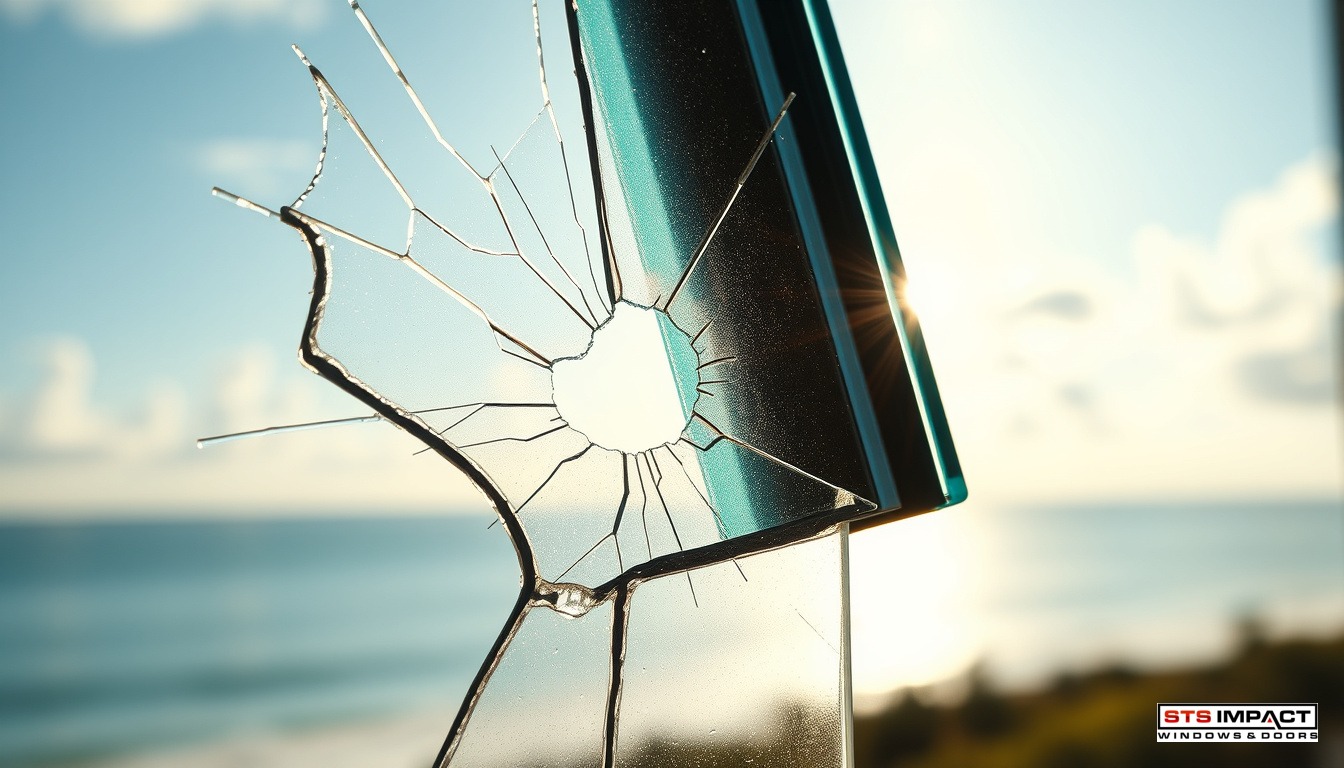
How Does the Glass in an Impact Window Actually Stop Flying Debris?
Impact windows use a laminated glass construction — two panes of tempered glass bonded around a clear polymer interlayer, typically made from polyvinyl butyral (PVB). When something strikes the glass with enough force, the outer pane may crack, but the interlayer holds the broken pieces in place. The window stays intact, the opening stays sealed, and wind pressure never gets inside your home.
What Makes Laminated Impact Glass Different From Regular Double-Pane Glass


A lot of homeowners assume double-pane or insulated glass is automatically strong enough for storm protection. It isn’t. Standard double-pane windows are built for thermal performance, not impact resistance. The two glass layers in a typical insulated unit are separated by an air gap and have nothing holding them together if they break.
Laminated impact glass works on a completely different principle. The interlayer acts like a membrane. Even after a strike from a 2×4 traveling at 34 miles per hour — which is part of Florida’s Florida Building Code large-missile impact test — a certified impact window can flex and crack without letting the debris through or allowing air pressure to equalize inside the structure.
That pressure equalization is the real danger during a hurricane. Once wind enters a compromised opening, it pushes upward on the roof from the inside. That’s how roofs get torn off. Keeping every opening sealed is the whole point of the system.
The Role of the Frame in Impact Performance
Glass alone doesn’t pass a hurricane test. The frame has to hold the glass under sustained wind loads, which in South Florida can mean design pressures exceeding 180 mph in some coastal zones. Aluminum frames are the most common choice here because they resist corrosion from salt air and don’t warp the way wood does after years of humidity cycles. The glass is set into the frame with a structural glazing compound that keeps it locked in place even when the frame flexes under load.
Installers in the Boca Raton area have to follow strict permitting requirements that verify both the product and the installation method meet local wind zone ratings. That’s not paperwork for its own sake — it’s the mechanism that ensures the frame, glass, and wall attachment all work as one system rather than three separate components that happen to be next to each other.
Tempered vs. Laminated: Why Both Matter
The glass layers inside an impact unit are usually tempered before the laminating process. Tempering makes glass roughly four times stronger than standard annealed glass and causes it to break into small, rounded fragments instead of large sharp shards. When you combine tempered strength with a PVB or SGP interlayer, you get a product that can absorb repeated strikes, stay in the frame, and still keep the opening weatherproof. Some higher-end units use SentryGlas (SGP) interlayers, which are stiffer and provide even more post-breakage rigidity — relevant for very large window openings common in newer construction along the coast.
If you want to see the range of glass and frame options available, the STS product lineup covers the main manufacturers and what distinguishes each one. Brands like PGT and CGI build products specifically rated for South Florida wind zones, which matters when a contractor pulls a permit for your home.
What the Installation Process Has to Do With Glass Performance
A well-made impact window installed incorrectly will still fail. The rough opening preparation, the anchor spacing into the masonry or wood framing, and the sealing around the perimeter all affect whether the window performs the way it was tested. Homes in the area built before the mid-1990s often have older construction methods that need extra attention during the retrofit process — things like concrete block walls that need specific anchor types or older buck framing that has to be evaluated before new units go in.
This is one reason local permitting offices require inspections at multiple stages of the job, not just a final sign-off. If you’re replacing windows on an older home and want to understand what that process looks like from start to finish, the STS FAQ page walks through common questions about timelines, permits, and what to expect on installation day.
Related Questions
Does the thickness of impact glass affect how much noise it blocks?
Yes, noticeably. Thicker laminated glass — especially units with a thicker interlayer or an asymmetric glass configuration, such as 3mm on one side and 5mm on the other — breaks up sound waves more effectively than equal-thickness panes. Many homeowners near busy roads in Boca Raton report a significant drop in traffic and ambient noise after switching from single-pane original windows to laminated impact glass, often without specifically shopping for acoustic performance. It’s a side benefit built into the same construction that handles wind and debris.
Can impact windows be installed in homes with non-standard or custom window shapes?
Custom shapes — arched tops, trapezoids, large fixed picture windows — are all possible with impact-rated glass, though they typically require factory orders rather than off-the-shelf units. Lead times run longer, and the cost per opening is higher because the frames and glass lites have to be cut and assembled to spec. Impact windows designed for Florida homes are available in a wide range of configurations from manufacturers who build specifically for the South Florida market, so even unusual openings generally have a code-compliant solution.


