

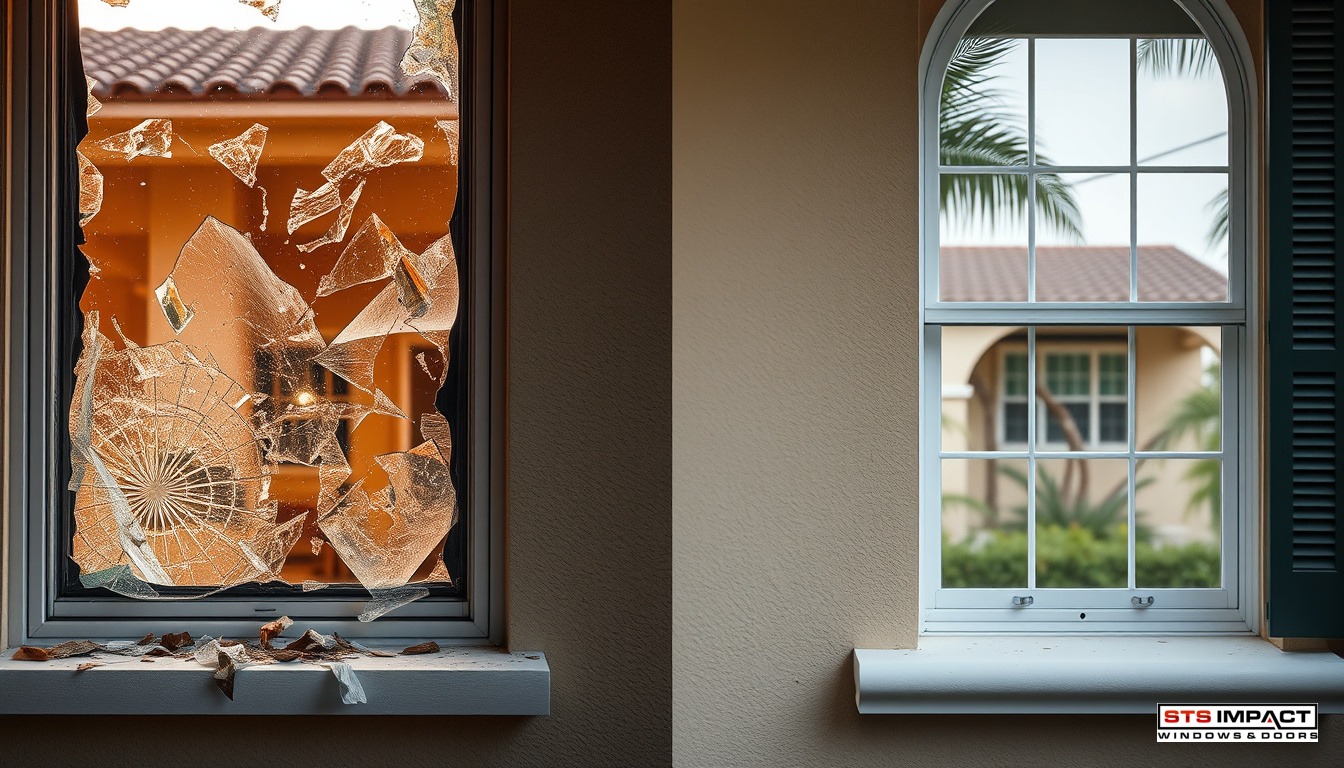
How Much Wind Can a Standard Window Actually Handle Before It Fails?
A standard single-pane or double-pane window — the kind found in most older Florida homes — typically begins to fail at wind speeds between 50 and 80 mph, well below what even a moderate hurricane delivers. Once the glass breaks, the pressure difference inside and outside the home can lift the roof. Impact-rated windows, by contrast, are engineered to hold up against winds exceeding 150 mph and the debris that travels with them.
Why Regular Windows Give Out So Fast in a Storm

Glass Isn’t the Only Problem
Most people assume a window breaks because the glass can’t take the wind. That’s part of it, but the frame matters just as much. Standard aluminum frames used in older construction weren’t tested under high-velocity hurricane zone (HVHZ) standards. The frames flex, the seals around the glass give way, and water and wind rush in long before the glass even shatters. In Boca Raton, where many neighborhoods still have original windows from the 1980s and 90s, this is a real and common problem.
The Physics of Pressure Buildup
When a window fails during a storm, the interior of the house instantly equalizes with the outside pressure. That surge is what causes so much structural roof damage — it’s not the wind pushing walls outward, it’s the pressurized air inside the home pushing upward on the roof structure. A broken window is essentially an open door for that process. The Florida Building Commission has documented this failure mode extensively and it’s a core reason the state updated its building code after Hurricane Andrew in 1992.
Flying Debris Is the Real Trigger
Wind speed alone rarely breaks a window cleanly. The actual failure point for most standard glass is windborne debris impact — a 2×4 piece of lumber traveling at 34 mph, which is the standard test projectile used in impact ratings. Standard double-pane glass shatters immediately under that load. Laminated impact glass uses two sheets of tempered glass bonded with a polyvinyl butyral (PVB) interlayer, so even if the outer pane cracks, the glass stays in the frame and the seal holds.
What Makes Impact Windows Different Structurally
The Glass Sandwich
The term “impact glass” refers specifically to that laminated construction. Think of it like a car windshield — it can crack on impact, but it doesn’t shatter into pieces. The PVB interlayer absorbs energy and keeps the glass in one place. Manufacturers like PGT Innovations, which produces windows used across South Florida, test every product under both the large missile and small missile impact protocols before it earns an impact rating.
Frame Engineering Matters Too
Beyond the glass, impact-rated frames are thicker, use heavier gauge aluminum or reinforced vinyl, and are anchored into the rough opening differently than standard windows. The fastener pattern and depth are specified by engineering drawings that go through the permitting process. This is why proper installation by a licensed contractor isn’t optional — a mis-installed impact window can still fail even if the glass itself is rated correctly. You can browse the window options available through STS on the Our Products page to see how these frame systems compare.
Testing Standards You Should Know
Florida uses two main test protocols: ASTM E1886/E1996 for large and small missile impact, and TAS 201/202/203 for the HVHZ designation required in Broward and Miami-Dade counties. Products that pass both are eligible for installation anywhere in the state. If a contractor can’t show you the product’s Notice of Acceptance (NOA), that’s a red flag. Local residents replacing windows should always ask for the NOA number and cross-check it before signing a contract. The STS FAQ page breaks down what these certifications mean in plain language.
Related Questions

Do impact windows require any special maintenance to keep their protective rating?
Not much, but a few things matter. Keep the tracks and weep holes clean so water doesn’t pool in the frame. Inspect the silicone sealant around the perimeter every couple of years — if it’s cracking or pulling away, have it reapplied. The glass itself doesn’t degrade, but the frame seals can over time, especially in the Florida heat. A quick annual checkover keeps everything performing as it should.
Can I mix impact windows with regular windows in the same house?
Technically yes, but it creates a weak point. Florida’s building code requires that if you’re using impact-rated openings as your primary storm protection, every opening in the building envelope needs to be protected. Mixing leaves unprotected openings that can fail and trigger the pressure surge described above. If budget is a concern, many homeowners phase the project room by room over a couple of years — check the available discounts page or explore financing options to help spread the cost.


